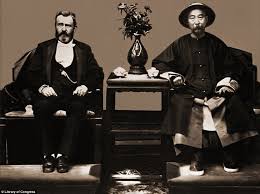
Complicity and Christian mission is an important coupling to consider. Christopher Sneller, a fellow PhD student during my time at King’s College London, has written a piece I wish to highlight. He summarizes how the tea and opium trade between China and Great Britain and the resulting humiliating Opium Wars (1839-60) damaged the “national Chinese psyche” and Western relations, including missionaries. A few missionaries even served as translators on the opium clippers and for the very government treaties that crippled China but opened wide the access into the country for their simultaneous pursuit of sharing the Christian gospel. Other missionaries, however, exposed and condemned opium trafficking and Britain’s involvement.
History provides us myriad examples of those laboring in the name of Christ doing much good while overlooking other wrongs. I think of the Puritans whom Kevin Olusola (K.O.) of Propaganda among others have called out. I think of A.W. Tozer who penned several Christian classics as his family suffered; Trevin Wax recaps such duplicity here. I think of Martin Luther King Jr.’s amazing leadership and yet presumably his failed leadership in his own marriage. Before we are tempted to lose hope, I can also recount countless others who, while human, have shone brightly. I think of Sir Thomas More. I think of Sojourner Truth, William Wilberforce, Dietrich Bonhoeffer, Mother Teresa, Elizabeth Elliot, and the scores of those poor or mistreated who, despite injury and squalor, were faithful to God profoundly. I suggest that the collusion of missionaries, church leaders, or whomever else should not drive us to despair or apathy; rather, we should be driven to sobriety. Should we not take careful inventory of our own lives? Secondly, they provide us an opportunity to honestly recount history—the dynamic, complicated, mired, offensive, hopeful picture that it is. We need to own our history, the parts played, and the consequent promotion or disadvantage granted to certain groups because of it.
A student asked me over lunch one day, “How did the missionaries get it so wrong?” She pointed to slavery, the commodification of evangelism with imperialism, etc. I responded, “No one gets history right all or even most of the time. Each of us is born with cultural constraints, some of which we don’t recognize, much less question. In one sense, they did the best they could with what they had. We may trust that their hearts desired to honor God, but they were still constrained in doing that well. This is not to excuse their behavior by any means, but can we judge them based on our hindsight? The percolation of cultural change is slow. Even as blind spots blotted the missionaries’ methods and attitudes, they in their brokenness were still used to forge great change. I think of William Carey, Amy Carmichael, Francis Xavier, and Alexander Duff, all of whom brought sweeping change to the marginalized in India, for example, through linguistics, literacy, health care, and education. Missionary failures do us a sad service in this: they remind us how easy it is to get it wrong and call us to be extremely critical in evaluating ourselves.”
Unfortunately, hindsight does not ensure foresight, which leads me to ask myself:
In what have I been complicit?
“A particular evil not only inhabits us so that we do what we hate (Romans 7:15), it has colonized us to such a thoroughgoing extent that there seems to be no moral space left within the self in which it could occur to us to hate what we want because it is evil.” – Miroslav Volf, Exclusion and Embrace, p. 89-90.


Alleged “Missionaries” who were complicit in slavery, the commodification of evangelism with imperialism, etc. I feel the need to pushback to your point of evaluating their experience to being culturally complacent or being “persons of their time,” so to speak. I think it creates this false sense of distance between the mentality of missionaries back then and some currently who carry those same imperialist, white supremacist, capitalist, patriarchal, and xenophobic ideologies that still remain toxic and act as barriers between forming relationships which in essence is the basis for most conservative evangelical perspectives. I fear that if evangelicals ( not you in particular, just generally speaking) do not seek to critically address the moral failures of previous generations and critically examine how the same views, ideas, and beliefs transfer throughout generations and fail to call out the sins of so-called “missionaries” that were complicit in the oppression of others, and not just Christians who were just merely “persons of their time,” we may miss the lessons that could positively impact future generations and the nations as a whole.
Hi there, Monét. I agree. Complicity continues over centuries. We do not excuse those missionaries as merely “persons of their time” nor suppose that those cultural blinders (and sins) are not still being worn today. Thank you!